Nursing is one of the most respected and essential professions in the healthcare sector. A nurse is not only a caregiver but also a trained medical professional who understands the human body, patient care, and medical procedures. From assisting doctors to managing emergencies, nurses are often at the front line of healthcare services.
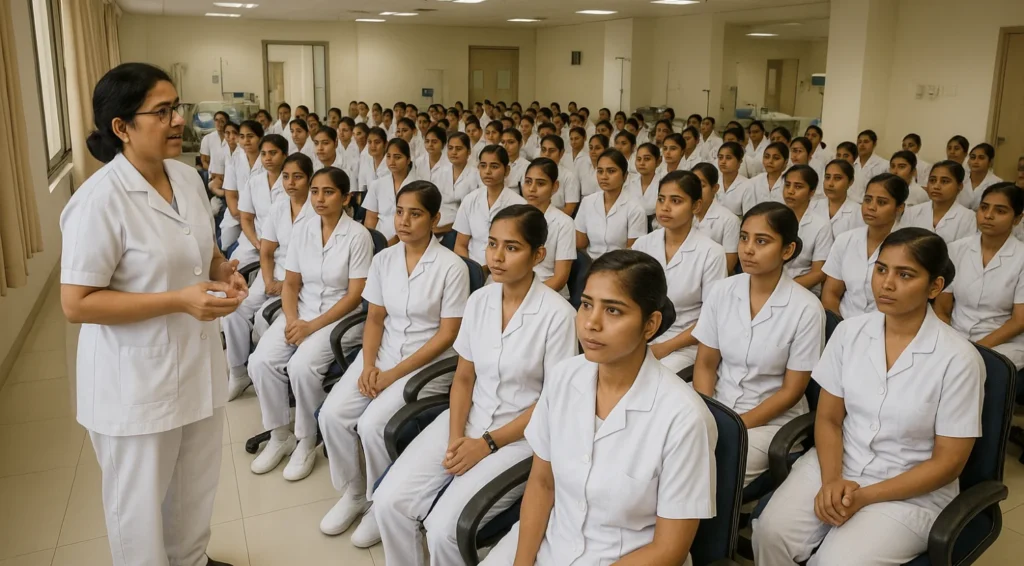
In recent years, with the rise of new diseases, pandemics, and increasing demand for quality healthcare, the need for trained nurses has grown significantly in India. Hospitals, clinics, and even community health centres now require skilled nursing staff in large numbers. This has made nursing a popular career choice among students after completing their higher secondary education.
Who Can Study Nursing?
To pursue nursing in India, students generally need to complete their Class 12 (Higher Secondary) with the following conditions:
- Mandatory subjects: Physics, Chemistry, and Biology.
- Minimum marks: At least 45% aggregate in these subjects (some institutes require higher percentages).
- English: Must be studied as a compulsory subject in Class 12.
Also Read: AIIMS NORCET 9 Notification 2025 Released for 3500 Nursing Officer Posts
Major Entrance Exams for Nursing Courses in India
Students who have completed Class 12 can apply for various entrance exams to get admission into nursing programs. Some of the important national and state-level exams are:
NEET (National Eligibility cum Entrance Test) – Conducted by NTA; many institutes use NEET scores for B.Sc Nursing admissions.
AIIMS Nursing Exam – Held by the All India Institute of Medical Sciences, New Delhi, for B.Sc and M.Sc Nursing courses in its campuses.
PGIMER Nursing Exam – Conducted by the Post Graduate Institute of Medical Education and Research, Chandigarh.
JIPMER Nursing Exam – Organized by the Jawaharlal Institute of Postgraduate Medical Education and Research, Puducherry.
Indian Army B.Sc Nursing Exam – Held by the Directorate General of Medical Services for nursing in Armed Forces hospitals.
GENPAS UG – Conducted by West Bengal Joint Entrance Examination Board for nursing and other paramedical courses.
BHU Nursing Entrance Exam – Conducted by Banaras Hindu University.
CMC Vellore Nursing Entrance – Held by Christian Medical College, Vellore.
State-Level Nursing Entrance Exams – Many states like Kerala, Maharashtra, Karnataka, and Gujarat have their own entrance tests for government and private nursing colleges.
Apart from these, some private universities and colleges also conduct their own admission tests.
Also Read: BFUHS Staff Nurse Recruitment 2025 Notification Out for 406 Vacancies
Types of Nursing Courses in India
Nursing education in India is regulated by the Indian Nursing Council (INC). The council approves all recognized nursing programs across the country. There are several levels of courses, from diplomas to doctoral degrees.
1. Diploma Courses
- ANM (Auxiliary Nurse Midwifery) – Duration: 2 years. Focuses on basic healthcare, maternity care, and community health services.
- GNM (General Nursing and Midwifery) – Duration: 3 years. Trains students in patient care, hospital work, and midwifery.
2. Undergraduate Courses
- B.Sc Nursing (Basic) – Duration: 4 years. Covers all aspects of nursing, anatomy, physiology, community health, and clinical training.
- B.Sc Nursing (Post Basic) – Duration: 2 years (regular) or 3 years (distance mode). For students who already have a GNM diploma.
3. Postgraduate Courses
- M.Sc Nursing – Duration: 2 years. Specializations include Medical-Surgical Nursing, Pediatrics, Psychiatry, Obstetrics & Gynecology, and Community Health.
4. Research and Advanced Courses
- M.Phil in Nursing – Duration: 1 year (full-time) or 2 years (part-time). Focus on research methods and teaching.
- Ph.D. in Nursing – Duration: 3–5 years. Research-based doctoral program.
5. Post Basic Diploma in Specialized Nursing (1 Year)
Specializations include:
- Operation Room Nursing
- Cardio-Thoracic Nursing
- Neurology Nursing
- Midwifery Nursing
- Psychiatric Nursing
- Critical Care Nursing
- Emergency & Disaster Nursing
- Oncology Nursing
- Orthopedic & Rehabilitation Nursing
- Geriatric Nursing
- Neonatal Nursing
- Forensic Nursing
- Hematology Nursing
- Burn & Reconstructive Nursing
6. Nurse Practitioner in Critical Care (NPCC)
- Duration: 2 years.
- Focus on advanced critical care practice.
Also Read: WBHRB Staff Nurse Recruitment 2025 Notification Out for 5018 Vacancies, Check Details Here
Top Nursing Colleges in India (State-wise)
Here’s a list of some of the most reputed nursing institutions across India, recognized by the INC:
Delhi & NCR
- All India Institute of Medical Sciences (AIIMS), New Delhi
- Rajkumari Amrit Kaur College of Nursing, Delhi University
Tamil Nadu
- Christian Medical College (CMC), Vellore
- Apollo College of Nursing, Chennai
- SRM College of Nursing, Kattankulathur
Karnataka
- St. John’s College of Nursing, Bengaluru
- Manipal College of Nursing, Manipal Academy of Higher Education
- R.V. College of Nursing, Bengaluru
Kerala
- Government College of Nursing, Thiruvananthapuram
- Amrita College of Nursing, Kochi
Maharashtra
- Tata Memorial Hospital, Mumbai
- Byramjee Jeejeebhoy Government Medical College & Sassoon General Hospitals, Pune
Punjab
- Post Graduate Institute of Medical Education and Research (PGIMER), Chandigarh
- Christian Medical College, Ludhiana
Uttar Pradesh
- Banaras Hindu University (BHU), Varanasi
- King George’s Medical University (KGMU), Lucknow
West Bengal
- Medical College and Hospital, Kolkata
- IPGMER & SSKM Hospital, Kolkata
- R.G. Kar Medical College, Kolkata
- NRS Medical College, Kolkata
Andhra Pradesh & Telangana
- Nizam’s Institute of Medical Sciences, Hyderabad
- College of Nursing, Sri Venkateswara Institute of Medical Sciences, Tirupati
Rajasthan
- College of Nursing, SMS Medical College, Jaipur
Gujarat
- Government College of Nursing, Ahmedabad
- Smt. NHL Municipal Medical College, Ahmedabad
These colleges are known for quality training, experienced faculty, and strong placement networks in reputed hospitals.
Job Opportunities After Nursing
After completing nursing studies, graduates can work in multiple healthcare and related fields. Common career options include:
- Staff Nurse – Hospital or clinic-based patient care.
- Nursing Teacher/Faculty – Teaching in nursing colleges or training institutes.
- Nursing Manager – Supervising nursing staff and managing healthcare facilities.
- Legal Nurse Consultant – Assisting in medical-legal cases.
- Nurse Anesthetist – Assisting with anesthesia during surgeries.
- Midwife – Specializing in childbirth and maternity care.
- Community Health Nurse – Working in rural or urban community health programs.
- Critical Care Nurse – Working in ICUs and emergency departments.
- Research Nurse – Conducting medical and nursing research.
Scope of Nursing in India and Abroad
In India: With the expansion of healthcare facilities, both in the public and private sectors, nurses are in high demand. Government hospitals, military services, primary health centres, and private chains like Apollo, Fortis, and Max regularly hire trained nurses.
Abroad: Countries like the UK, USA, Canada, Australia, and Gulf nations offer excellent career opportunities for Indian nurses, provided they clear the licensing exams (NCLEX, HAAD, DHA, etc.).
FAQs on Nursing Career in India
Q1. Can I study nursing after Class 12 without Biology?
Ans: No. Biology is mandatory along with Physics and Chemistry for most nursing courses.
Q2. What is the minimum percentage required for B.Sc Nursing?
Ans: Usually 45% in Class 12 (PCB), but top colleges may require 50% or more.
Q3. Is NEET compulsory for nursing?
Ans: Not always. Some colleges use NEET scores, while others have their own entrance exams or merit-based admission.
Q4. Which nursing course is best after Class 12?
Ans: B.Sc Nursing is the most popular choice for those aiming for a long-term career in nursing.
Q5. Can male students become nurses in India?
Ans: Yes. Nursing is open to all genders in India.
Q6. How much can a nurse earn in India?
Ans: Fresh graduates earn around ₹20,000–₹35,000 per month, and experienced nurses earn much more.
Q7. Is a nursing degree from India valid abroad?
Ans: Yes, but you may need to clear licensing exams like NCLEX (USA) or DHA/HAAD (Gulf).
Q8. Can I do nursing through distance education?
Ans: Only certain Post Basic Nursing courses are available in distance mode, not basic B.Sc Nursing.