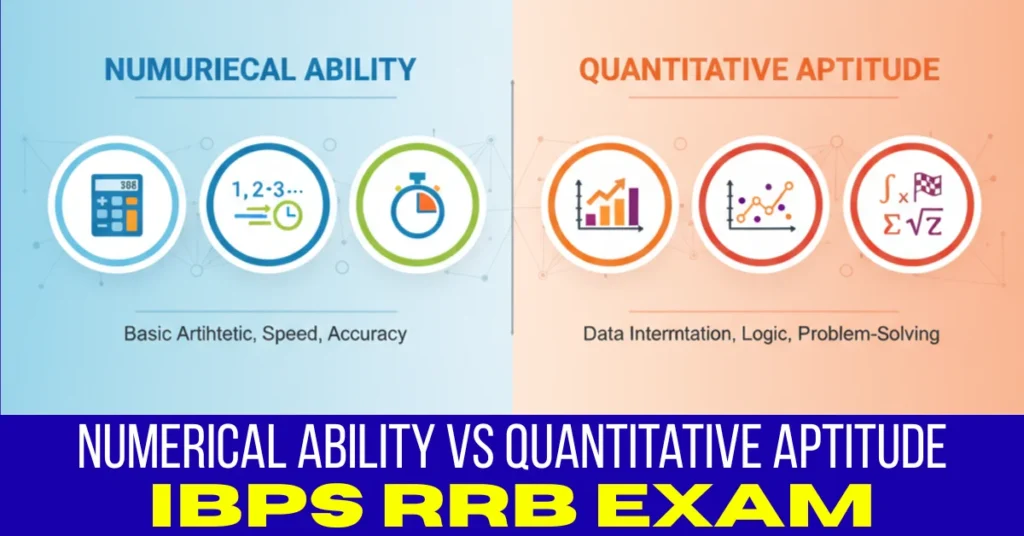
Numerical Ability vs Quantitative Aptitude in IBPS RRB: The IBPS RRB Recruitment 2025 (क्षेत्रीय ग्रामीण बैंक) notification is out for 13,217 vacancies. The Institute of Banking Personnel Selection (IBPS) conducts this exam to select candidates for Office Assistant and Officer Scale I posts in Regional Rural Banks across India. Both these posts have a written exam pattern with subjects like Reasoning, General Awareness, Computer Knowledge, and a section related to numbers and calculations. For Office Assistants, this section is called Numerical Ability, while for Officer Scale I it is named Quantitative Aptitude.
This article explains the difference between Numerical Ability and Quantitative Aptitude in the IBPS RRB Exam syllabus. Understanding this difference will help candidates prepare smartly according to the post they are applying for.
IBPS RRB 2025 Exam Overview
The IBPS RRB 2025 exam is conducted in online mode.
- Office Assistant (Clerk): Prelims and Mains
- Officer Scale I (PO): Prelims, Mains, and Interview
For Prelims, both posts have 40 questions in the maths section with 40 marks. In the Mains exam, the maths section has 40 questions for 50 marks. But the type and difficulty of questions are not the same.
Also Read: IBPS RRB Participating Regional Rural Banks (RRBs) 2025 and Vacancy List [CRP RRBs XIV]
Numerical Ability vs Quantitative Aptitude in IBPS RRB Exam
Among these sections, two areas-Numerical Ability and Quantitative Aptitude-often confuse aspirants. While they sound similar and are both based on mathematics, they are not identical in purpose, complexity, or level of questions. Understanding this difference is crucial for effective preparation, especially since Office Assistant exams contain Numerical Ability while Officer Scale I exams contain Quantitative Aptitude.
Numerical Ability in IBPS RRB Office Assistant Exam
The Numerical Ability section is designed for clerical level posts. The aim is to test basic calculation skills and speed. It checks whether a candidate can quickly perform everyday banking tasks like handling cash, checking totals, and managing ledgers.
Important Topics
- Number System
- Simplification
- Percentages
- Ratio and Proportion
- Averages
- Time and Work
- Time and Distance
- Simple and Compound Interest
- Profit and Loss
- HCF & LCM
- Basic Data Interpretation (Bar Graph, Line Graph, Pie Chart)
Nature of questions:
- Generally easier in difficulty compared to quantitative aptitude
- Mostly direct calculation-based
- Less analytical and more about speed with numbers
- Frequently includes simplification and approximation problems
Also Read: IBPS RRB Clerk Syllabus 2025, Office Assistant Exam Pattern
Quantitative Aptitude in IBPS RRB Officer Scale I Exam
The Quantitative Aptitude section is for the officer-level post. This section is more advanced and needs logical analysis in addition to calculation. It tests a candidate’s ability to solve complex business and financial problems.
Important Topics
- All topics from Numerical Ability
- Advanced Data Interpretation (Case Study Graphs, Mixed Charts)
- Probability
- Permutation and Combination
- Advanced Arithmetic Problems
Nature of questions:
- More challenging compared to numerical ability
- Problem-solving with multi-step calculations
- Involves analytical decision-making
- Heavy emphasis on data interpretation and caselets
Also Read: IBPS RRB PO Syllabus & Exam Pattern 2025: Subject-wise Topics for Prelims & Mains
Difference in Numerical Ability vs Quantitative Aptitude
The main difference between Numerical Ability and Quantitative Aptitude lies in the difficulty level. Numerical Ability is simpler and is designed for clerical level posts like Office Assistants. The focus is on accuracy and speed with basic arithmetic. Quantitative Aptitude is tougher and is meant for Officer Scale I posts.
| Aspect | Numerical Ability (Clerks) | Quantitative Aptitude (Officer Scale I) |
|---|---|---|
| Level | Basic mathematics | Advanced and analytical |
| Focus | Fast calculations, accuracy | Logical analysis, data interpretation |
| Difficulty | Easier, entry-level | Moderate to difficult |
| Topics | Simplification, percentages, ratio, time & distance | Includes higher-level topics like DI, probability, permutation-combination |
| Application | Tests basic arithmetic skills needed for clerical work | Tests problem-solving and decision-making ability for managerial tasks |
| Exam Section | Office Assistant (Prelims & Mains) | Officer Scale I (Prelims & Mains) |
Why the Difference Exists?
The difference is intentional because of the job roles being assessed:
Office Assistants (Clerks) mainly perform recording, ledger maintenance, cash handling, and customer assistance. These require basic number skills more than analytical ones. Hence, numerical ability suffices for evaluation.
Officer Scale I (POs), however, are future managers responsible for decision-making, loan approvals, calculations of interests, and financial analysis. These duties demand data analysis, logical ability, and application-based mathematics. Therefore, quantitative aptitude is tested.
Preparation Tips
For Office Assistant Numerical Ability, candidates should focus on quick calculation methods, tables, and mental maths. Practice topics like Simplification, Percentages, and Time & Distance every day. For Officer Scale I Quantitative Aptitude, aspirants must practise Data Interpretation sets, advanced arithmetic, and probability problems.
Regular mock tests and time management are very important for both sections. Strong basics and regular revision of formulas will help to score high.
Numerical Ability vs Quantitative Aptitude: FAQs
Q1. What is the difference between Numerical Ability and Quantitative Aptitude in IBPS RRB exams?
Numerical Ability is part of the Office Assistant exam and tests basic arithmetic like percentages, ratios, and time-speed-distance, while Quantitative Aptitude in Officer Scale I exam includes advanced problem-solving, data interpretation, and analytical topics.
Q2. Which IBPS RRB posts require Numerical Ability and which require Quantitative Aptitude?
Numerical Ability is asked in the Office Assistant (Clerk) exam. Quantitative Aptitude is part of the Officer Scale I (PO) exam. Both roles test reasoning alongside these sections.
Q3. How should I prepare differently for Numerical Ability and Quantitative Aptitude?
For Numerical Ability, focus on speed and accuracy in basic arithmetic. For Quantitative Aptitude, practice higher-level mathematics, data interpretation, and logical problem-solving to develop strong analytical skills.