The Central Board of Secondary Education (CBSE) has officially announced a significant change in its registration and examination processes. Starting with the 2026 board examinations, it will be mandatory for all students in Classes 9 to 12 to link their APAAR ID with their academic records. This move comes alongside an increase in examination and registration fees for the academic year 2025–26 and the launch of an AI-powered digital experience centre in New Delhi.
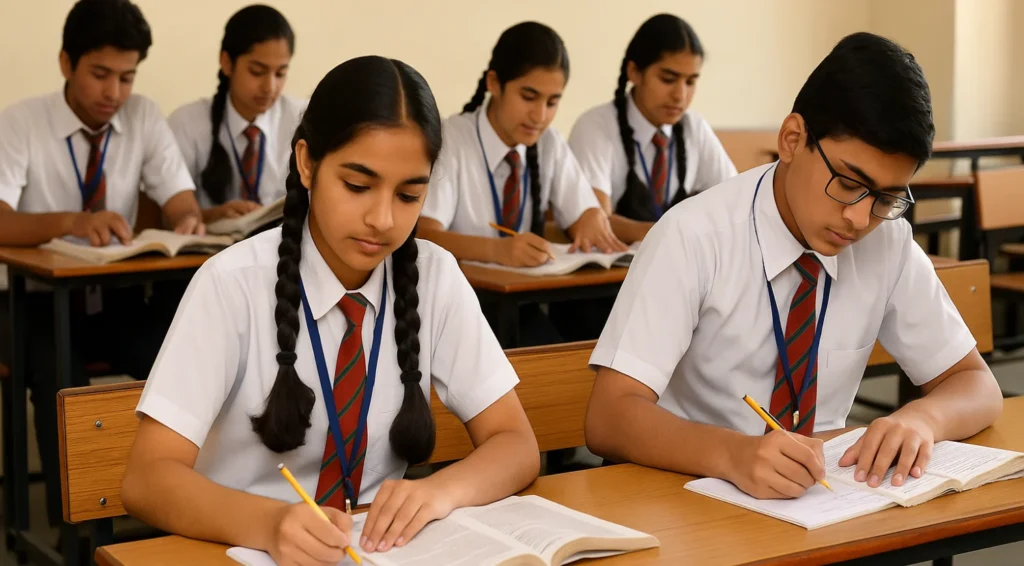
These measures are part of CBSE’s efforts to strengthen academic transparency, improve data management, and embrace digital education tools in line with the National Education Policy (NEP) 2020 and the Digital India mission.
Main Objective of the CBSE APAAR ID System
APAAR stands for Automated Permanent Academic Account Registry, a unique 12-digit identifier created by the Ministry of Education under the “One Nation, One Student ID” initiative. Its purpose is to provide a lifelong digital academic identity for every student, consolidating all educational achievements, certificates, and credits in a secure online platform. Integrated with DigiLocker and the Academic Bank of Credits (ABC), this ID will allow students to seamlessly access and transfer their academic records throughout their educational journey and even during professional life.
The APAAR system will also reduce duplication, improve accuracy in student databases, and simplify verification for institutions, employers, and examination authorities.
Also Read: Complete Guide to Using Bharat Aadhaar Seeding Enabler (BASE)
Who Needs to Link APAAR ID?
From the academic year 2025–26, the following rules apply:
- Classes 9 and 11: APAAR ID must be linked at the registration stage.
- Classes 10 and 12: APAAR ID must be linked during the List of Candidates (LoC) submission.
All CBSE-affiliated schools are instructed to collect APAAR IDs from students well before registration deadlines to ensure compliance.
CBSE Revised Exam and Registration Fees for 2025–26
For the first time since 2020, CBSE has increased fees for examinations and registrations to meet rising operational costs.
Examination Fee (Class 10 & 12)
- One theory subject: ₹320 (India), ₹1100 (Nepal), ₹2200 (Other countries)
- Five theory subjects: ₹1600 (India), ₹5500 (Nepal), ₹11000 (Other countries)
Practical Subjects (Class 12 only): ₹160 (India), ₹175 (Nepal), ₹375 (Other countries)
Registration Fee
- Class 9: ₹320 (India), ₹550 (Nepal & other countries)
- Class 11: ₹320 (India), ₹660 (Nepal & other countries)
Also Read: OASIS Scholarship 2025-Complete Application Guide, Eligibility, and Benefits
AI-Powered Digital Experience Centre
CBSE will set up an AI-driven digital experience centre at its Integrated Office Complex in Sector 23, Dwarka, New Delhi. This facility will offer an interactive, technology-rich learning space where students can engage with academic content in innovative ways. The centre aims to encourage curiosity, improve comprehension, and promote advanced digital literacy among students.
Benefits of APAAR ID for Students
- Creates a single lifelong academic identity.
- Facilitates smooth academic credit transfers through DigiLocker and ABC.
- Serves as a primary identifier for national entrance exams like JEE, NEET, and CUET.
- Helps eliminate duplicate and inconsistent records in the education system.
- Simplifies document verification for admissions and job applications.
Implementation Process for Schools
- Generate APAAR IDs for all students via the UDISE+ portal.
- Organise parent-teacher meetings to explain the requirement and obtain consent.
- Verify all student data before generating IDs.
- Distribute APAAR IDs to students and ensure they are linked to academic records.
- Monitor compliance through the APAAR ID Monitoring (AIM) portal.
Schools are advised to complete the process promptly to avoid disruptions during registration and board exam submissions.
APAAR ID and the NEP 2020 Vision
The APAAR initiative supports the NEP 2020’s goals of promoting transparency, student mobility, and digital integration in education. By linking APAAR IDs, CBSE is moving towards a unified education database that will make transitions between schools, colleges, and universities smoother for students.
Source – Time of India
FAQs
Q1: What is the APAAR ID?
It is a 12-digit permanent academic identifier that securely stores all educational records and achievements.
Q2: Who needs to link their APAAR ID?
From 2026 onwards, all CBSE students in Classes 9 to 12 must have their APAAR ID linked.
Q3: Can APAAR ID be used for competitive exams?
Yes, it will act as a primary identifier for JEE, NEET, CUET, and similar national-level exams.
Q4: How is the APAAR ID generated?
Schools generate it via the UDISE+ portal after verifying student data and obtaining parental consent.