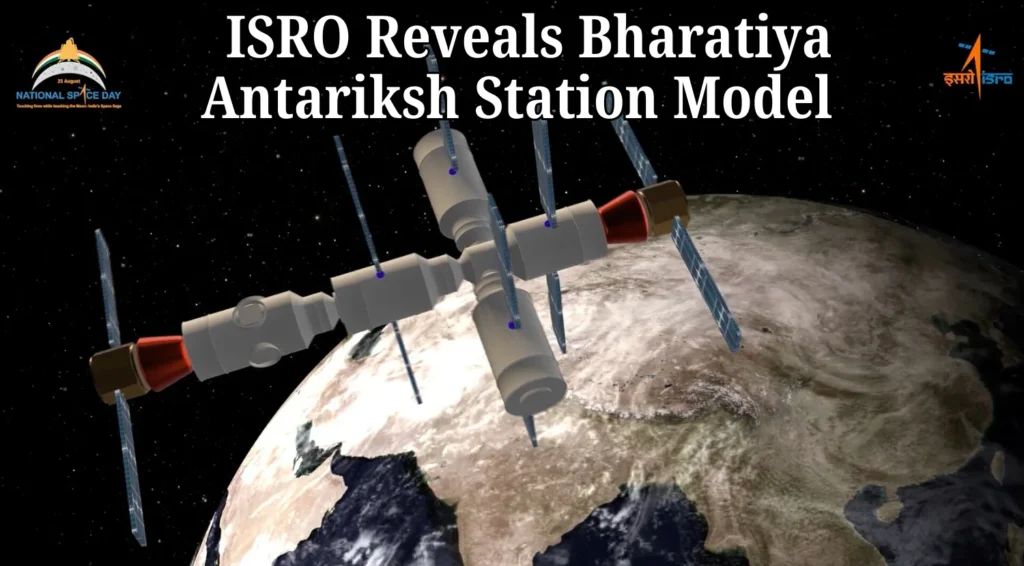
ISRO has unveiled the first model of its ambitious Indian space station, the Bharatiya Antariksh Station (BAS), aiming to launch its first module by 2028 and complete the station with five modules by 2035, making India one of the few countries with its own orbital laboratory. This major step not only boosts India’s global space profile but also promises new opportunities in science, technology, and education for students
What is the Bharatiya Antariksh Station?
The Bharatiya Antariksh Station (BAS) is India’s first planned space station, developed entirely by ISRO. BAS is designed to orbit the Earth at a height of about 450 km and will ultimately consist of five separate modules. The first module, called BAS-01, is set to be launched in 2028 and weighs around 10 tonnes. The complete station will be ready by 2035, increasing India’s capability in space research.
Salient Features of Bharatiya Antariksh Station
BAS is packed with many advanced and indigenous features:
- An Environmental Control and Life Support System (ECLSS) to keep astronauts safe and healthy
- Bharat Docking System and Bharat Berthing Mechanism for connecting modules
- Automated hatch systems for easier access
- Special viewports for scientific imaging and astronaut recreation
- Refilling systems for fuel and essential fluids
- Protection from radiation, temperature changes, and space debris
- Airlocks and space suits to support space walks (extravehicular activity)
- Plug-and-play integrated avionics for easy technology upgrades
Research and Opportunities trough Bharatiya Antariksh Station
The BAS will provide a unique platform for microgravity research and technology demonstration. Scientists will be able to:
- Study the effects of weightlessness on the human body
- Innovate in medicine, biotechnology, and materials science
- Explore new technologies for living in space for long periods
- Prepare for future missions to the Moon or Mars
This research can also boost improvements in communication, agriculture, and healthcare here on Earth.
Also Read: India Post Goes Digital with IT 2.0 for Faster, Safer Deliveries
International Context and Comparisons
Currently, only the International Space Station (ISS), run by five space agencies, and China’s Tiangong space station are active in orbit. With BAS, India will join this exclusive group, showing the world India’s scientific strength and opening the door for international cooperation in space.
Inspiring the Next Generation
BAS is expected to inspire students and young people across India to dream big and pursue careers in science, technology, engineering, and mathematics (STEM). With the exciting vision of space tourism and more, the BAS promises to make space not just a scientist’s dream, but an exciting field for all students to explore.
Conclusion
India’s Bharatiya Antariksh Station is a giant leap in the country’s space journey, offering a test bed for new technologies, research, and international collaborations. With a simple vision and advanced features, ISRO’s home-grown space station is bound to open new frontiers for students, researchers, and all space enthusiasts in India.