GATE 2026 Syllabus and Exam Pattern: The Graduate Aptitude Test in Engineering (GATE) 2026 is one of the most competitive national-level examinations, conducted for admission to postgraduate programs and recruitment in Public Sector Undertakings (PSUs). The GATE 2026 examination will be organized by the Indian Institute of Technology Guwahati (IITG) and will be held for 30 different test papers.
Candidates can appear in either one or up to two test papers from the prescribed two-paper combinations. Each paper will include a General Aptitude section and a subject-specific section, with a total of 100 marks. The syllabus for each paper is different and must be carefully reviewed before preparation.
Also Check: GATE 2026 Registration From 28 Aug: Dates, Fees, Documents & Step-by-Step Process
GATE 2026 Syllabus and Exam Pattern: Overview
The GATE 2026 exam, conducted by IIT Guwahati, will be held for 30 papers in Computer-Based Test mode. Each paper will have a General Aptitude section and a subject-specific section, carrying a total of 100 marks. Candidates can appear in one or two allowed papers, and the questions will be of MCQ, MSQ, and NAT types. The exam will be in English and will test skills in recall, comprehension, application, analysis, and synthesis.
Also Read: GATE 2026 Exam Centres Released: Zone-Wise City List, How to Select & Add Centres
| Particulars | Details |
|---|---|
| Organizing Institute | Indian Institute of Technology Guwahati |
| Number of Papers | 30 |
| Papers Allowed per Candidate | 1 or 2 (as per approved combinations) |
| Mode of Examination | Computer-Based Test (CBT) |
| Language of Examination | English |
| Duration | 3 hours (180 minutes) |
| Sections | General Aptitude (GA) + Subject Paper |
| Type of Questions | MCQ, MSQ, and NAT |
| Testing Abilities | Recall, Comprehension, Application, Analysis & Synthesis |
| Total Marks | 100 |
| Negative Marking | Yes (MCQ only) |
GATE 2026 Exam Pattern
The GATE 2026 exam will have three types of questions – Multiple Choice Questions (MCQ), Multiple Select Questions (MSQ), and Numerical Answer Type (NAT). MCQs will have negative marking, MSQs will have no negative marking or partial marking, and NAT questions will also have no negative marking.
The exam will assess a candidate’s recall, comprehension, application, analysis, and synthesis skills.
GATE Exam Pattern Official Direct Link 2026
Distribution of Marks in GATE 2026
For most papers, except AR, CY, DA, EY, GE, GG, MA, PH, ST, XH, and XL, the marks are distributed as: 15 marks for General Aptitude, 13 marks for Engineering Mathematics, and 72 marks for subject questions, making a total of 100 marks.
For the remaining papers (AR, CY, DA, EY, GE, GG, MA, PH, ST, XH, and XL), the distribution is 15 marks for General Aptitude and 85 marks for subject questions, also totaling 100 marks.
Negative marking applies only to MCQs: 1-mark MCQs will deduct 1/3 mark for a wrong answer, and 2-mark MCQs will deduct 2/3 mark for a wrong answer. MSQ and NAT questions do not have any negative marking.
Also Read: GATE 2026 Website Launched, Check Eligibility and Important Dates
GATE 2026 Paper-Wise Pattern and Test Papers
The GATE 2026 examination is conducted across 30 different test papers, each with its own paper code, marks distribution, and section structure. The pattern varies slightly depending on the subject, especially for papers that have optional sections. Understanding the paper-wise pattern is important so candidates can prepare according to the exact structure of their chosen paper.
Paper-Wise Pattern Details
AE, AG, BM, BT, CE, CH, CS, EC, EE, ES, IN, ME, MN, MT, NM, PE, PI, TF
- General Aptitude (GA): 15 marks
- Subject (Compulsory Section): 85 marks
- Total: 100 marks
- Duration: 180 minutes
CY, DA, EY, MA, PH, ST
- General Aptitude (GA): 15 marks
- Subject (Compulsory Section): 85 marks
- Total: 100 marks
- Duration: 180 minutes
AR (Architecture and Planning)
- General Aptitude (GA): 15 marks
- Part A (Compulsory): 60 marks
- Part B1 (Architecture) or B2 (Planning): 25 marks
- Total: 100 marks
- Duration: 180 minutes
GE (Geomatics Engineering)
- General Aptitude (GA): 15 marks
- Part A (Compulsory): 55 marks
- Part B1 (Surveying & Mapping) or B2 (Image Processing & Analysis): 30 marks
- Total: 100 marks
- Duration: 180 minutes
GG (Geology & Geophysics)
- General Aptitude (GA): 15 marks
- Part A (Compulsory): 25 marks
- Part B1 (Geology) or B2 (Geophysics): 60 marks
- Total: 100 marks
- Duration: 180 minutes
XE (Engineering Sciences)
- GA: 15 marks
- Section A (Engineering Mathematics – Compulsory): 15 marks
- Any TWO optional sections: 35 marks each
- Total: 100 marks
- Duration: 180 minutes
XH (Humanities & Social Sciences)
- GA: 15 marks
- Section B1 (Reasoning & Comprehension – Compulsory): 25 marks
- Any ONE optional section: 60 marks
- Total: 100 marks
- Duration: 180 minutes
XL (Life Sciences)
- GA: 15 marks
- Section P (Chemistry – Compulsory): 25 marks
- Any TWO optional sections: 30 marks each
- Total: 100 marks
- Duration: 180 minutes
Also Read: Opportunities After GATE 2026: Explore Career Scope and Life After GATE Success
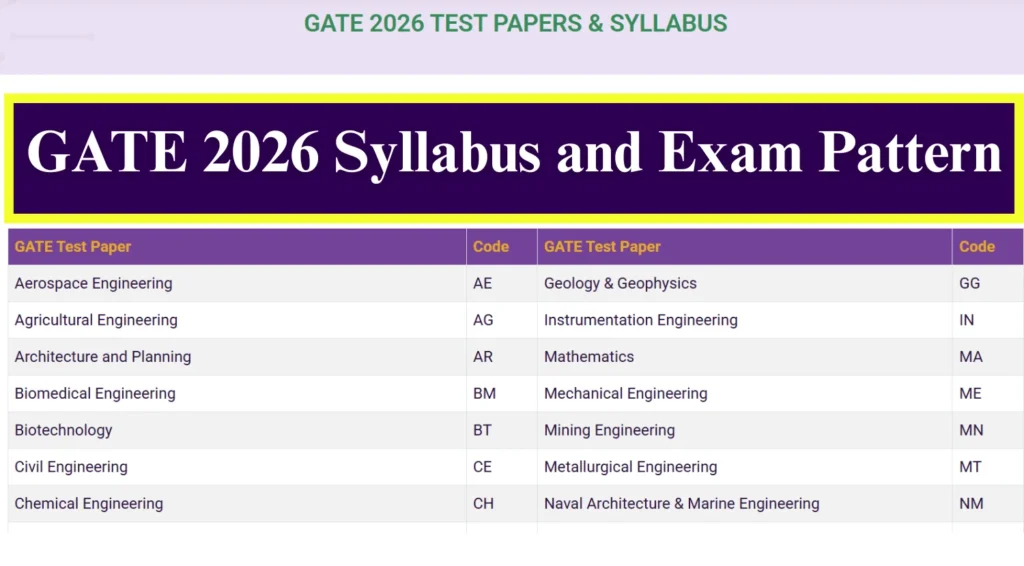
GATE 2026 Test Papers and Codes
| Paper Name | Code | Paper Name | Code |
|---|---|---|---|
| Aerospace Engineering | AE | Geology & Geophysics | GG |
| Agricultural Engineering | AG | Instrumentation Engineering | IN |
| Architecture and Planning | AR | Mathematics | MA |
| Biomedical Engineering | BM | Mechanical Engineering | ME |
| Biotechnology | BT | Mining Engineering | MN |
| Civil Engineering | CE | Metallurgical Engineering | MT |
| Chemical Engineering | CH | Naval Architecture & Marine Engineering | NM |
| Computer Science & Information Technology | CS | Petroleum Engineering | PE |
| Chemistry | CY | Physics | PH |
| Data Science & Artificial Intelligence | DA | Production & Industrial Engineering | PI |
| Electronics & Communication Engineering | EC | Statistics | ST |
| Electrical Engineering | EE | Textile Engineering & Fibre Science | TF |
| Environmental Science & Engineering | ES | Engineering Sciences | XE |
| Ecology and Evolution | EY | Humanities & Social Sciences | XH |
| Geomatics Engineering | GE | Life Sciences | XL |
Section Structure for XE, XH, and XL Papers
1. XE – Engineering Sciences
Compulsory Section: Engineering Mathematics (Section A) – 15 marks
Optional Sections (Any TWO – 35 marks each):
- B: Fluid Mechanics
- C: Materials Science
- D: Solid Mechanics
- E: Thermodynamics
- F: Polymer Science and Engineering
- G: Food Technology
- H: Atmospheric and Oceanic Sciences
- I: Energy Science
2. XH – Humanities & Social Sciences
Compulsory Section: Reasoning and Comprehension (B1) – 25 marks
Optional Sections (Any ONE – 60 marks):
- C1: Economics
- C2: English
- C3: Linguistics
- C4: Philosophy
- C5: Psychology
- C6: Sociology
3. XL – Life Sciences
Compulsory Section: Chemistry (P) – 25 marks
Optional Sections (Any TWO – 30 marks each):
- Q: Biochemistry
- R: Botany
- S: Microbiology
- T: Zoology
- U: Food Technology
GATE 2026 Syllabus PDF
The syllabus for each of the 30 test papers is available as a separate PDF on the official GATE 2026 website. Candidates must refer only to the official syllabus for preparation.
GATE Aerospace Engineering (AE) Syllabus 2026
The Graduate Aptitude Test in Engineering (GATE) 2026 – Aerospace Engineering (AE) syllabus, organized by IIT Guwahati. The question paper will contain 90% questions from core topics and 10% from special topics.
It covers six main sections: Engineering Mathematics, Flight Mechanics, Space Dynamics, Aerodynamics, Structures, and Propulsion. Each section is structured to test knowledge across fundamental concepts, analytical skills, and application in aerospace systems, ensuring that candidates are well-prepared for advanced study or careers in the aerospace industry. Check the below link for accurate syllabus Info.
Direct Official Aerospace Engineering Syllabus PDF Link
GATE Geology and Geophysics (GG) Syllabus 2026
The GATE 2026 Geology and Geophysics (GG) syllabus consists of a common section for all candidates, followed by two optional parts: B1 (Geology) and B2 (Geophysics). Candidates must answer the common section and either of the two optional sections. The syllabus integrates topics from fundamental Earth science principles to advanced analytical methods used in geological and geophysical investigations, resource exploration, and environmental applications. Check the below link for accurate syllabus Info.
Direct Official Geology and Geophysics Syllabus Link
FAQs
Q1. Who is conducting the GATE 2026 exam?
A: The GATE 2026 exam will be conducted by the Indian Institute of Technology Guwahati (IITG).
Q2. How many papers are there in GATE 2026?
A: There are 30 different test papers in GATE 2026.
Q3. Can I appear for two papers in GATE 2026?
A: Yes, you can appear in either one or two papers, but only from the allowed two-paper combinations.
Q4. What types of questions are asked in GATE 2026?
A: The question paper will have MCQs (with negative marking), MSQs (no negative marking), and NATs (no negative marking).
Q5. Is there negative marking in GATE 2026?
A: Yes, only for MCQs — 1-mark MCQs have a penalty of 1/3 mark, and 2-mark MCQs have a penalty of 2/3 mark for wrong answers.
Q6. What is the total duration of the GATE exam?
A: The total duration of the exam is 3 hours (180 minutes).
Q7. What is the syllabus for GATE 2026?
A: The syllabus is different for each paper. It includes General Aptitude for all papers and subject-specific topics. The detailed syllabus PDFs are available on the official GATE 2026 website.
Q8. What is the total marks in GATE 2026?
A: The total marks for each paper are 100.
Q9. What is the role of General Aptitude in GATE 2026?
A: General Aptitude is common to all papers and carries 15 marks.
It is very useful topic for me
Thank you for this kind of information
as I am 2nd year cse student of btech
I am very interested to approve the gate exam
But I didn’t start at
Hi Mahima, thank you so much for your kind words We’re glad the article was helpful for you. Since you are in 2nd year CSE, this is the perfect time to slowly start preparing for GATE 2026. Even if you begin with the basics now, it will give you a big advantage later.
You can go through the syllabus we shared in the article and start with the fundamental subjects of CSE. Don’t worry if you haven’t started yet — consistency is the key. We’ll keep posting study tips and resources to guide you along the way.
Best wishes for your preparation
IndiaExamAlert Team